Social Media for B2B vs. B2C Brands: What Actually Works
July 26th 2026
A typical B2B buying decision now involves six to ten stakeholders, each researching independently before your team ever hears from them, according to Gartner's 2024 buying-journey research. A B2C purchase, by contrast, can happen in the time it takes to scroll past a product post. That gap in decision-making is why "B2B vs B2C social media strategy" isn't a question of tone - it's a different design problem with different platforms, content formats, and success metrics.
Most brands still run one social media playbook across both audiences. It's why so many B2B pages read like consumer ads, and why B2C accounts sometimes sound like investor decks. Here's what the data says actually works on each side — and where the line between them is blurring.
Why the Same Playbook Doesn't Work Twice
B2B buying is a committee sport. Forrester's State of Business Buying, 2024 report puts the average B2B purchase at 13 stakeholders, with nearly 89% of decisions crossing multiple departments. Gartner's parallel research narrows this to a typical range of six to ten decision-makers for complex purchases, each arriving with their own independently gathered research. Content has to work for a buying group, not a buyer — it needs to travel between departments and hold up under internal scrutiny.
B2C buying looks nothing like this. One person, often making a fast, emotion-led call. Industry survey data compiled by Dreamgrow in 2025 found that 81% of people report making impulse purchases influenced by something they saw on social media, with 28% doing so monthly. There's no internal buy-in required - just a reason to act now.
This single difference - one decision-maker versus a committee - shapes almost everything else: platform choice, content format, and what "engagement" is even supposed to achieve.
What Actually Works for B2B Social Media
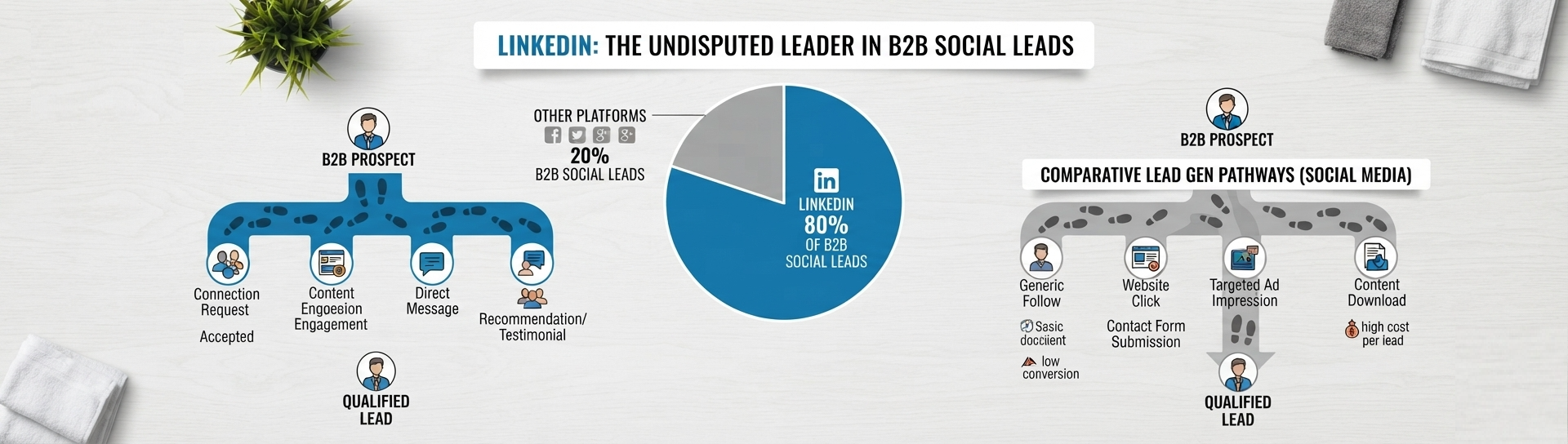
LinkedIn is not optional for B2B. Multiple 2025 industry benchmarking reports, including one compiled by DSMN8 using LinkedIn's own B2B data, put LinkedIn's share of B2B social leads at around 80%. That dominance holds because LinkedIn is where buying committees actually research vendors - not just where companies post updates.
Format matters more than most brands assume. The same DSMN8 analysis found document carousels achieving engagement rates above 6%, well ahead of standard text posts, and reported that 78% of B2B marketers now use video in their content mix. Thought leadership carries real commercial weight too: the 2025 Edelman x LinkedIn Thought Leadership Impact Report found that 55% of decision-makers use thought leadership content as part of how they vet a potential partner.
The practical takeaway: B2B social content should read like proof, not promotion - case studies, process breakdowns, and named-expert commentary that a stakeholder can forward to a colleague without having to explain it first.
What Actually Works for B2C Social Media
For B2C, Instagram and short-form video carry the weight LinkedIn carries for B2B. The 2025 Sprout Social Index found that 29% of Instagram users make purchases directly on the platform, making it the third most-used app for shopping. Discovery happens earlier than most brands plan for - over 60% of Instagram users report following or researching brands and products on the app itself, per multiple 2025 platform usage reports.
Influencer and creator partnerships remain one of the highest-return levers available. Dreamgrow's 2025 roundup cites an average return of $5.20 for every dollar spent on influencer marketing, and found that 64% of consumers are more likely to buy from a brand when it partners with a creator they already follow.
The format that wins is different too: visual storytelling, UGC-style content, and short video outperform static posts and long-form copy almost everywhere on the B2C side. Speed and relatability beat polish.
Where the Two Overlap — and Where Brands Get It Wrong
The gap between B2B and B2C social is narrowing faster than most agencies acknowledge. A 2026 MarTech analysis found that 54% of B2B buyers now make purchase decisions after encountering a product on Instagram, describing the platform as a legitimate full-funnel channel for B2B rather than a distraction from LinkedIn. Separately, compiled social-selling research shows 75% of B2B buyers use social media generally to inform purchasing decisions - research behaviour that looks increasingly close to how B2C shoppers browse before buying.
The most common mistake is treating the audience label as the strategy. B2C brands sometimes default to a corporate, feature-led tone because "professional" feels safer - but that undercuts the emotional, visual hook that drives impulse behaviour on platforms like Instagram. B2B brands make the opposite mistake: dismissing Instagram and short-form video as irrelevant, when a growing share of buying committees are using exactly those formats to validate a vendor before a sales call ever happens.
The fix isn't a single unified voice. It's matching content format and platform to how that specific audience actually makes decisions - solo and fast, or shared and deliberate.
Metrics tend to expose the mismatch fastest. A B2C team chasing follower growth on Instagram is measuring the right thing for that audience - reach feeds impulse behaviour. A B2B team chasing the same follower count on LinkedIn is often optimising for vanity, when what actually predicts pipeline is content shares among a small number of relevant stakeholders, not broad reach among strangers. Applying B2C engagement benchmarks to a B2B account - or vice versa - usually means reporting on the wrong number to leadership.
Building the Right Social Media Mix for Your Brand
Start by mapping where your buyers actually are in their decision process, not which platform your team prefers posting on.
For B2B brands:
- Prioritise LinkedIn as the primary channel
- Invest in document carousels and short-form video
- Build a thought-leadership cadence around named experts inside the company
- Let case studies and client results carry more weight than brand messaging
For B2C brands:
- Prioritise Instagram and short-form video first
- Build a creator and influencer bench rather than relying on paid reach alone
- Design content for the scroll — visual, fast, and emotionally direct rather than feature-heavy
Budget allocation should follow the same logic. A B2B account gains little from influencer spend and loses little by posting less frequently, since the buying cycle is measured in months, not minutes. A B2C account loses momentum quickly if posting slows, since the platform's algorithm and audience attention both reward consistency. Treating both accounts against the same weekly quota or the same paid-media split usually shortchanges one side.
For brands that sell into both audiences - an FMCG company running consumer campaigns while also pitching enterprise retail buyers, for example - the two strategies need to run in parallel, not blend into one feed. This is a pattern we see often at Designbox, working across both B2B clients like Kohler and Hindware and consumer-facing packaging and branding work. The content strategy, platform mix, and even the brand identity that supports it are built differently depending on who's actually making the buying decision.
If you're weighing how to split - or connect - your B2B and B2C social presence, our social media marketing team can walk through what that looks like for your specific audience mix.
Frequently Asked Questions
Q: Is LinkedIn or Instagram better for B2B brands? A: LinkedIn remains the primary lead-generation channel for B2B, generating roughly 80% of B2B social leads per 2025 industry benchmarks. Instagram is increasingly used earlier in the B2B journey for research and validation, but it supplements LinkedIn rather than replacing it.
Q: What's the biggest structural difference between B2B and B2C social strategy? A: Decision-making structure. B2B purchases typically involve six to ten stakeholders researching independently (Gartner, 2024), while B2C purchases are usually made by one person, often on impulse. Content needs to be built for a committee versus an individual.
Q: Should B2B brands invest in Instagram at all? A: Yes. A 2026 MarTech analysis found 54% of B2B buyers make purchase decisions after seeing a product on Instagram. The platform now functions as a genuine full-funnel B2B channel, not just a B2C tool.
Q: What content format performs best for B2B lead generation? A: Document carousels and short-form video currently outperform standard text posts, with carousels achieving engagement rates above 6% in 2025 benchmarking data. Case studies and named thought-leadership content also carry measurable weight in vendor vetting.
Q: Can one agency handle both B2B and B2C social strategy for the same company? A: Yes, but it requires running genuinely separate content strategies - different platforms, formats, and voice — rather than one unified feed. Brands serving both audiences see the clearest results when each audience gets its own plan.
Conclusion
The B2B vs B2C social media debate isn't really about platforms - it's about how your specific audience makes decisions. A buying committee needs proof it can pass around; an individual consumer needs a reason to act in the next ten seconds. Brands that build content around that distinction, rather than around a generic "brand voice," consistently outperform those treating social media as one channel with one playbook.
If you're not sure which mix fits your business — or you're trying to run both at once — get in touch with Designbox to talk through a strategy built for how your buyers actually decide.